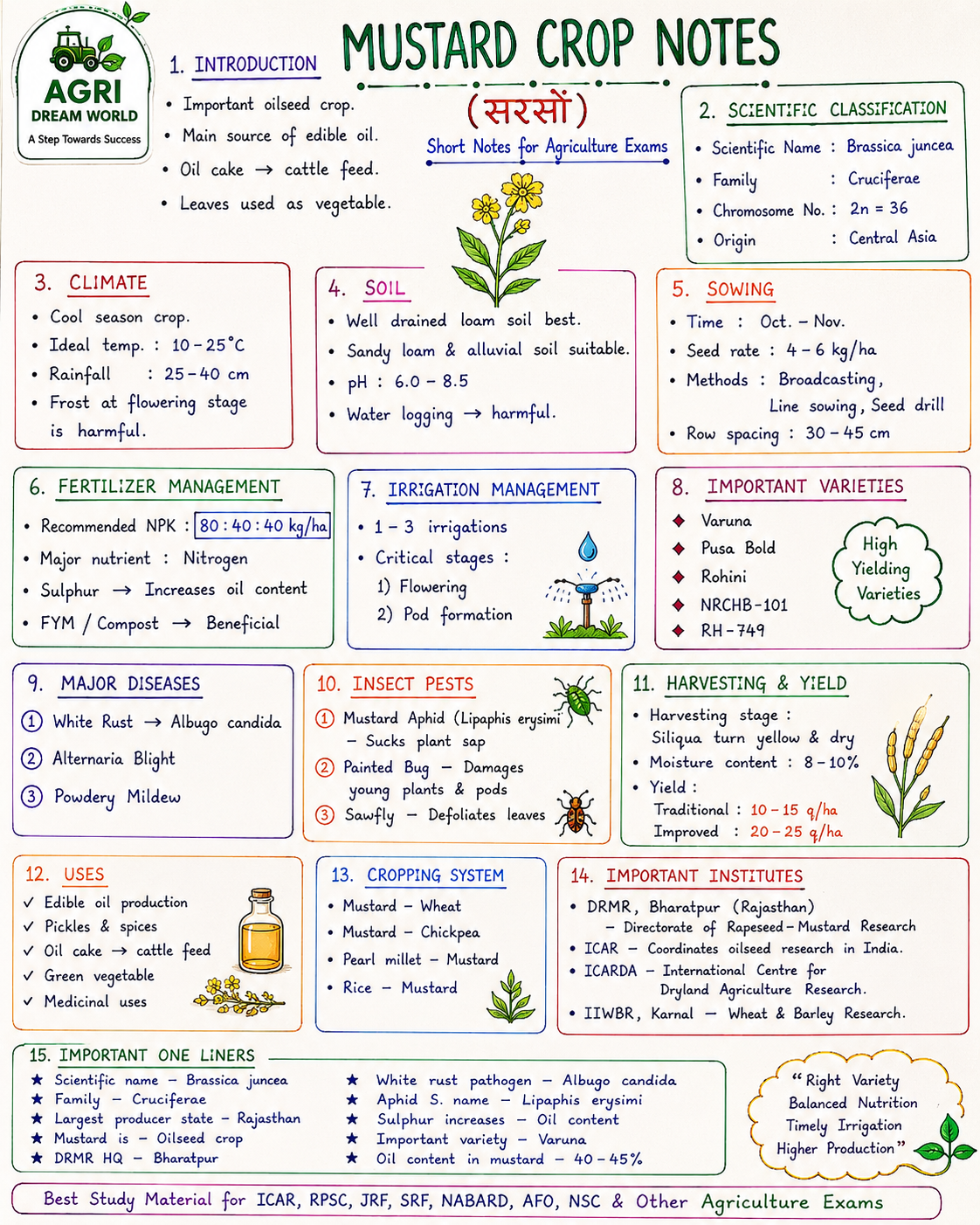
Mustard Crop Complete Notes for Agriculture Exams
सरसों फसल सम्पूर्ण नोट्स – कृषि परीक्षाओं के लिए
Mustard Crop Notes Introduction
Mustard Crop Notes Climate and Soil
Mustard Crop Notes Important Varieties
Mustard Crop Notes Irrigation Management
Mustard Crop Notes Fertilizer Management
Mustard Crop Notes Diseases and Pest Management
Mustard Crop Notes Research Institutes
Mustard Crop Notes Important One Liner Questions
Introduction of Mustard
सरसों का परिचय
Mustard is one of the most important oilseed crops of India. It is mainly cultivated for edible oil production and plays a major role in Indian agriculture economy. Mustard seeds are rich in oil and protein.
सरसों भारत की प्रमुख तिलहनी फसलों में से एक है। इसका उपयोग मुख्य रूप से खाद्य तेल उत्पादन के लिए किया जाता है। सरसों के बीज तेल एवं प्रोटीन से भरपूर होते हैं।
Scientific Classification
वैज्ञानिक वर्गीकरण
| Particular | Details |
|---|---|
| Scientific Name | Brassica juncea |
| Family | Cruciferae / Brassicaceae |
| Chromosome Number | 2n = 36 |
| Origin | Central Asia |
Importance of Mustard
सरसों का महत्व
- Important oilseed crop
- Used for edible oil production
- Oil cake used as cattle feed
- Leaves used as vegetable
- Important source of income for farmers
- Suitable for crop rotation
सरसों भारत की प्रमुख तिलहनी फसल है तथा इसका तेल भोजन एवं औद्योगिक उपयोगों में प्रयोग किया जाता है।
Major Mustard Producing Countries
प्रमुख सरसों उत्पादक देश
Top Producing Countries:
- India
- Canada
- China
- Pakistan
- Germany
Largest Mustard Producing State in India:
- Rajasthan
Major Producing States:
- Rajasthan
- Uttar Pradesh
- Haryana
- Madhya Pradesh
- West Bengal
Climate Requirement
जलवायु
Mustard is a cool season crop.
सरसों शीत ऋतु की फसल है।
| Stage | Temperature |
|---|---|
| Germination | 20–25°C |
| Growth | 18–22°C |
| Flowering | 10–15°C |
Rainfall Requirement:
- 25–40 cm rainfall is ideal.
Harmful Condition:
- Frost at flowering stage is harmful.
Soil Requirement
मिट्टी
Mustard grows best in fertile well-drained soils.
Suitable Soils:
- Loam soil
- Sandy loam soil
- Alluvial soil
Soil pH:
- 6.0–8.5
Special Feature:
- Waterlogging is harmful.
Important Research Institutes
महत्वपूर्ण अनुसंधान संस्थान
1. DRMR
Full Form:
Directorate of Rapeseed-Mustard Research
Location:
Bharatpur, Rajasthan
Importance:
Main mustard research institute in India.
3. ICARDA
Full Form:
International Center for Agricultural Research in Dry Areas
Importance:
Research on oilseed and dryland crops.
Seasons and Sowing Time
बुवाई का समय
| Operation | Time |
|---|---|
| Sowing | October–November |
| Harvesting | February–March |
Land Preparation
खेत की तैयारी
- 2–3 ploughings required
- Fine seed bed preparation
- Proper leveling important
Seed and Sowing
बीज एवं बुवाई
Seed Rate:
| Crop Type | Seed Rate |
|---|---|
| Mustard | 4–6 kg/ha |
Sowing Methods:
- Broadcasting
- Line sowing
- Seed drill method
Row Spacing:
- 30–45 cm
Fertilizer Management
उर्वरक प्रबंधन
Recommended NPK:
- 80:40:40 kg/ha
Major Nutrient:
- Nitrogen
Important Micronutrient:
- Sulphur
Role of Sulphur:
- Increases oil content in seeds.
Irrigation Management
सिंचाई प्रबंधन
Critical Stages:
- Flowering stage
- Pod formation stage
Number of Irrigations:
- 1–3 irrigations depending on moisture availability
Weed Management
खरपतवार नियंत्रण
Major Weeds:
- Chenopodium album
- Cyperus rotundus
- Phalaris minor
Herbicides:
- Pendimethalin
- Isoproturon
Important Mustard Varieties
सरसों की प्रमुख किस्में
| Variety | Feature |
|---|---|
| Varuna | High yielding |
| Pusa Bold | Popular variety |
| Rohini | Early maturity |
| NRCHB-101 | High oil content |
Diseases of Mustard
सरसों के प्रमुख रोग
1. White Rust
Pathogen:
- Albugo candida
Symptoms:
- White pustules on leaves
2. Alternaria Blight
Symptoms:
- Brown spots on leaves and siliqua
3. Powdery Mildew
Symptoms:
- White powdery growth on leaves
Insect Pests of Mustard
सरसों के प्रमुख कीट
1. Mustard Aphid
Scientific Name:
- Lipaphis erysimi
Damage:
- Sucks plant sap
2. Painted Bug
Damage:
- Damages young plants and pods
Harvesting
कटाई
Harvesting Stage:
- Siliqua become yellow and dry
Moisture Content:
- 8–10%
Yield of Mustard
सरसों की उपज
| Type | Yield |
|---|---|
| Traditional | 10–15 q/ha |
| Improved varieties | 20–25 q/ha |
Uses of Mustard
सरसों के उपयोग
- Edible oil production
- Pickles and spices
- Oil cake for cattle feed
- Green vegetable
- Medicinal uses
Cropping Systems
फसल प्रणाली
- Mustard-Wheat
- Mustard-Chickpea
- Pearl millet-Mustard
- Rice-Mustard
Nutritional Value
पोषण मूल्य
Mustard contains:
- Oil
- Protein
- Minerals
- Vitamins
Special Component:
- Rich in essential fatty acids
Modern Technologies in Mustard Cultivation
सरसों उत्पादन की आधुनिक तकनीकें
Technologies:
- Zero tillage
- Precision farming
- Climate smart agriculture
- Integrated nutrient management
- Integrated pest management (IPM)
Important One Liner Questions
महत्वपूर्ण वन लाइनर प्रश्न
- Scientific name of mustard – Brassica juncea
- Family of mustard – Cruciferae
- Largest mustard producer state – Rajasthan
- DRMR located at Bharatpur
- Mustard is oilseed crop
- White rust caused by Albugo candida
- Mustard aphid scientific name – Lipaphis erysimi
- Sulphur increases oil content
- Varuna is important variety
- Mustard grown mainly in Rabi season
Conclusion
निष्कर्ष
Mustard is one of the most important oilseed crops contributing significantly to edible oil production in India. Scientific cultivation practices, improved varieties, balanced fertilization, and integrated pest management are essential for obtaining higher mustard productivity.
सरसों भारत की प्रमुख तिलहनी फसल है। वैज्ञानिक खेती, उन्नत किस्मों, संतुलित उर्वरक उपयोग एवं उचित कीट प्रबंधन द्वारा इसकी उत्पादकता बढ़ाई जा सकती है।