Sorghum Crop Complete Notes for Agriculture Exams
ज्वार फसल सम्पूर्ण नोट्स – कृषि परीक्षाओं के लिए
Sorghum Crop Notes Introduction
Sorghum Crop Notes Climate and Soil
Sorghum Crop Notes Important Varieties
Sorghum Crop Notes Irrigation Management
Sorghum Crop Notes Fertilizer Management
Sorghum Crop Notes Diseases and Pest Management
Sorghum Crop Notes Research Institutes
Sorghum Crop Notes Important One Liner Questions
Introduction of Sorghum
ज्वार का परिचय
Sorghum is one of the important millet crops grown in India and many semi-arid regions of the world. It is commonly known as Jowar and is used as food, fodder, and feed crop. Sorghum is highly drought tolerant and suitable for dryland farming.
ज्वार भारत एवं विश्व के अर्ध-शुष्क क्षेत्रों की प्रमुख मोटे अनाज (Millet) फसल है। इसे ज्वार कहा जाता है तथा इसका उपयोग भोजन, पशु चारा एवं दाने के रूप में किया जाता है। ज्वार सूखा सहनशील फसल है।
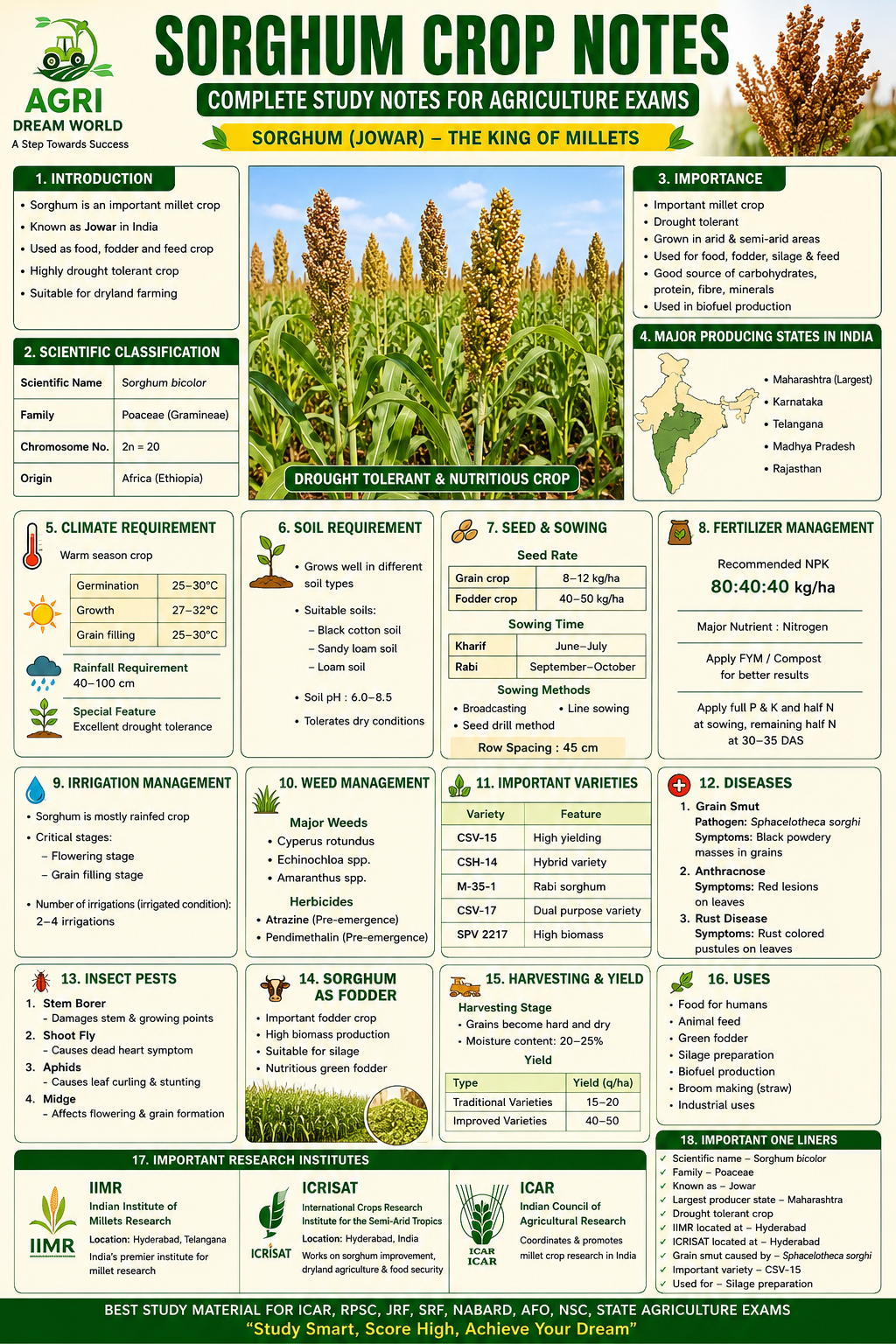
Scientific Classification
वैज्ञानिक वर्गीकरण
| Particular | Details |
|---|---|
| Scientific Name | Sorghum bicolor |
| Family | Poaceae / Gramineae |
| Chromosome Number | 2n = 20 |
| Origin | Africa (Ethiopia) |
Importance of Sorghum
ज्वार का महत्व
- Important millet crop
- Drought tolerant crop
- Used as food and fodder
- Suitable for dryland farming
- Rich source of carbohydrates and protein
- Used in silage preparation
ज्वार शुष्क क्षेत्रों की महत्वपूर्ण खाद्यान्न एवं चारा फसल है।
Major Sorghum Producing Countries
प्रमुख ज्वार उत्पादक देश
Top Producing Countries:
- USA
- Nigeria
- India
- Sudan
- Ethiopia
Largest Sorghum Producing State in India:
- Maharashtra
Major Producing States:
- Maharashtra
- Karnataka
- Telangana
- Madhya Pradesh
- Rajasthan
Climate Requirement
जलवायु
Sorghum is a warm season crop.
ज्वार गर्म जलवायु की फसल है।
| Stage | Temperature |
|---|---|
| Germination | 25–30°C |
| Growth | 27–32°C |
| Grain filling | 25–30°C |
Rainfall Requirement:
- 40–100 cm rainfall
Special Feature:
- Excellent drought tolerance
Soil Requirement
मिट्टी
Sorghum grows well in different soil types.
Suitable Soils:
- Black cotton soil
- Sandy loam soil
- Loam soil
Soil pH:
- 6.0–8.5
Special Feature:
- Tolerates dry conditions
Important Research Institutes
महत्वपूर्ण अनुसंधान संस्थान
1. IIMR
Full Form:
Indian Institute of Millets Research
Location:
Hyderabad, Telangana
Importance:
Main millet research institute in India.
2. ICRISAT
Full Form:
International Crops Research Institute for the Semi-Arid Tropics
Location:
Hyderabad, India
Importance:
Global research on sorghum and dryland agriculture.
Seasons of Sorghum Cultivation
ज्वार की खेती के मौसम
| Season | Time |
|---|---|
| Kharif | June–July |
| Rabi | September–October |
Land Preparation
खेत की तैयारी
- 2–3 ploughings required
- Fine seed bed preparation
- Proper leveling essential
Seed and Sowing
बीज एवं बुवाई
Seed Rate:
| Purpose | Seed Rate |
|---|---|
| Grain crop | 8–12 kg/ha |
| Fodder crop | 40–50 kg/ha |
Sowing Methods:
- Broadcasting
- Line sowing
- Seed drill method
Row Spacing:
- 45 cm
Fertilizer Management
उर्वरक प्रबंधन
Recommended NPK:
- 80:40:40 kg/ha
Major Nutrient:
- Nitrogen
Organic Sources:
- FYM
- Compost
Irrigation Management
सिंचाई प्रबंधन
Sorghum is mostly rainfed crop.
Critical Stages:
- Flowering stage
- Grain filling stage
Number of Irrigations:
- 2–4 irrigations under irrigated condition
Weed Management
खरपतवार नियंत्रण
Major Weeds:
- Cyperus rotundus
- Echinochloa species
- Amaranthus species
Herbicides:
- Atrazine
- Pendimethalin
Important Sorghum Varieties
ज्वार की प्रमुख किस्में
| Variety | Feature |
|---|---|
| CSV-15 | High yielding |
| CSH-14 | Hybrid variety |
| M-35-1 | Rabi sorghum |
| CSV-17 | Dual purpose |
Sorghum as Fodder Crop
चारा फसल के रूप में ज्वार
Sorghum is an important fodder crop.
Advantages:
- High biomass production
- Suitable for silage
- Nutritious green fodder
Diseases of Sorghum
ज्वार के प्रमुख रोग
1. Grain Smut
Pathogen:
- Sphacelotheca sorghi
Symptoms:
- Black powdery masses in grains
2. Anthracnose
Symptoms:
- Red lesions on leaves
3. Rust Disease
Symptoms:
- Rust colored pustules on leaves
Insect Pests of Sorghum
ज्वार के प्रमुख कीट
1. Stem Borer
Damage:
- Damages stem and growing points
2. Shoot Fly
Damage:
- Causes dead heart symptom
Harvesting
कटाई
Harvesting Stage:
- Grains become hard and dry
Moisture Content:
- 20–25%
Yield of Sorghum
ज्वार की उपज
| Type | Yield |
|---|---|
| Traditional | 15–20 q/ha |
| Improved varieties | 40–50 q/ha |
Uses of Sorghum
ज्वार के उपयोग
- Human food
- Animal feed
- Green fodder
- Silage preparation
- Biofuel production
Cropping Systems
फसल प्रणाली
- Sorghum-Pigeonpea
- Sorghum-Chickpea
- Sorghum-Wheat
- Sorghum-Mustard
Nutritional Value
पोषण मूल्य
Sorghum contains:
- Carbohydrates
- Protein
- Fiber
- Minerals
- Vitamins
Special Feature:
- Gluten free cereal crop
Modern Technologies in Sorghum Cultivation
ज्वार उत्पादन की आधुनिक तकनीकें
Technologies:
- Precision farming
- Climate smart agriculture
- Improved hybrid technology
- Integrated nutrient management
- Integrated pest management
Important One Liner Questions
महत्वपूर्ण वन लाइनर प्रश्न
- Scientific name of sorghum – Sorghum bicolor
- Family of sorghum – Poaceae
- Sorghum known as Jowar
- Largest producer state – Maharashtra
- IIMR located at Hyderabad
- ICRISAT located at Hyderabad
- Sorghum is drought tolerant crop
- Grain smut caused by Sphacelotheca sorghi
- CSV-15 is important variety
- Sorghum used for silage preparation
Conclusion
निष्कर्ष
Sorghum is an important millet crop suitable for dryland and drought-prone areas. Scientific cultivation methods, improved varieties, balanced fertilizer application, and integrated pest management are essential for higher sorghum productivity.
ज्वार शुष्क एवं सूखा प्रभावित क्षेत्रों की महत्वपूर्ण मोटा अनाज फसल है। वैज्ञानिक खेती एवं आधुनिक तकनीकों द्वारा इसकी उत्पादकता बढ़ाई जा सकती है।